

Vitiligo
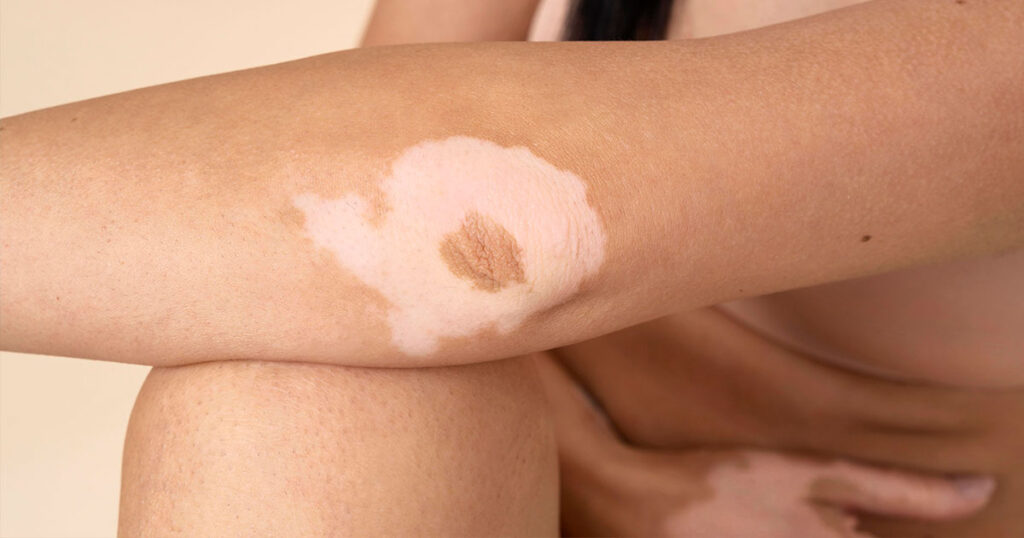
At Optimum Dermatology, we provide the safest, most effective, advanced, and innovative treatments for vitiligo,based on the patient’s age and severity of the condition. Early intervention is vital, as the sooner vitiligo is addressed, the more effective the treatment will be.
- Expertise, experience, and long‑term scientific training
• Advanced know‑how
• Comprehensive and effective treatments
What is vitiligo?
Vitiligo is an autoimmune, non‑contagious disease, characterized by depigmented areas on the skin, appearing as white patches. In addition to the skin, the mucous membranes of the mouth and nose, as well as the interior of the eye globes, may be affected.
In areas with hair, the hair may become white. This condition can present at any age, but often appears between ages 20 and 30, affecting both sexes, with more pronounced symptoms in individuals with darker skin
Etiology
Vitiligo is caused by an erroneous attack of the immune system on melanocytes through proteins called cytokines.
Some researchers suggest it affects individuals who inherit certain genes, making them susceptible to skin depigmentation. Others believe it may be triggered by sunburns or emotional stress. If vitiligo occurs in an area that has suffered trauma, such as a cut or burn, the Koebner phenomenon is observed (the appearance of new skin lesions of a pre-existing dermatosis on areas of cutaneous injury in otherwise healthy skin).
Symptoms
White patches develop on the skin, mainly in sun‑exposed areas such as the hands, legs, arms, and face. However, they may also appear around the mouth, eyes, armpits, navel, and groin. If the eyes are affected, the retina at the back of the eye is involved, while the iris color remains unchanged.
The spread of vitiligo on the skin is unpredictable. In some individuals, the condition may remain stable for many years, while in others it may progress rapidly in a short period. Timely and correct intervention is critical to prevent further spread.
Forms of vitiligo
Segmental vitiligo
Segmental vitiligo involves depigmentation in areas on only one side of the body. It is usually seen in young people and children, and its progression usually stops after one to two years.
Non‑segmental vitiligo
Non‑segmental vitiligo is characterized by symmetrical distribution of depigmented areas on both sides of the body, such as both hands. White patches gradually spread, usually starting around the eyes or mouth, and are more likely to appear on sun‑exposed areas like the face, neck, and hands. This form is further divided into subcategories:
- Generalized: Involves extensive white areas on the body.
- Focal: Most common form in children, with a few scattered spots.
- Universal: Extends over almost the entire body (typically up to 80%).
- Acral‑facial: Appears on upper and lower extremities, mainly on fingers, around the mouth and eyes.
- Mucosal vitiligo: Affects mucous membranes of the mouth, nose, and genital organs.
Mixed vitiligo
Mixed vitiligo is a rare form that initially appears as segmental and then progresses to non‑segmental vitiligo.
Diagnosis of vitiligo
For accurate diagnosis, the patient’s medical history is investigated, both individual and family history. In addition, a series of tests are recommended to rule out other medical conditions.
Treatments for vitiligo
The goal of successful vitiligo treatment is to restore skin color so the complexion appears uniform. The appropriate therapy is chosen based on the extent of vitiligo and the patient’s tolerance to various methods.
After clinical assessment of the severity of vitiligo, the dermatologist will recommend the most effective treatment for you. Available therapeutic options include:
- Phototherapy with monochromatic narrow‑band light, either localized via Excimer Light device or whole‑body using a Waldmann booth.
- Medication with topical preparations.
- Depigmentation of healthy skin to achieve uniform lightening, suggested only when vitiligo covers extensive body surface.
Phototherapy: The most modern vitiligo treatment
Narrow‑band monochromatic phototherapy is considered the most suitable treatment for segmental and generalized vitiligo, according to the European Academy of Dermatology.
The FDA‑approved Excimer Light device is especially effective for localized disease. Sessions are performed 2–3 times per week for faster results, with no side effects.
The treatment emits light at 308–311 nm wavelength and works via two mechanisms: immune suppression (reducing immune attack on melanocytes) and cytokine stimulation (activating growth factors from keratinocytes).
Phototherapy enhances melanin synthesis in affected areas and targets skin chromophores such as keratinocytes and melanocytes. The therapeutic light action encourages melanin production, leading to skin repigmentation. It also achieves disease control, inflammation reduction, repigmentation of white patches, and prevention of new patches, with treatment duration up to 12 months.
Phototherapy with Excimer Light has been scientifically shown to be safer and more effective than PUVA photochemotherapy (psoralen plus UVA). Major benefits include:
- Disease stabilization and increased repigmentation rates.
- No side effects such as itching, sunburns, blisters, hyperpigmentation, or increased risk of skin cancer.
- Emission of monochromatic light at a safe wavelength (308 nm), avoiding harmful UVB rays.
- Use of therapeutic light properties without affecting adjacent normal tissues.
- Faster results and better skin response.
- Applicability to children, pregnant and breastfeeding women, and individuals with renal or hepatic dysfunction.
Phototherapy is easy, painless, and suitable for combination with topical corticosteroids, vitamin D preparations, and anti‑inflammatories, for enhanced results. It shows high success in cases of:
• Early‑stage vitiligo.
• Vitiligo on the face, especially around the eyes.
• Presence of pigmentation in hair follicles in affected areas.
Combination of phototherapy and cream for non‑segmental vitiligo
The new Janus kinase (JAK) inhibitor cream represents an innovative treatment for non‑segmental vitiligo, approved by the FDA. Its key ingredient, ruxolitinib, acts as a topical JAK inhibitor aiming to repigment the skin.
The cream is intended for adults and children over 12 years of age with non‑segmental vitiligo. Clinical studies have shown that its use results in 75 %–90 % improvement after 6 months of treatment. Notably, when combined with phototherapy, improvement in facial vitiligo reaches 95 %.
This combined approach represents a significant advancement in treating non‑segmental vitiligo, offering an effective solution to restore uniform skin color.
Other recommended topical treatments
In early stages of non‑segmental vitiligo, topical corticosteroid creams have proven beneficial but are indicated for a limited duration.
Alternatives for longer use include topical calcineurin inhibitors such as tacrolimus and pimecrolimus, which help in pigment restoration.